Sunday, August 7, 2011

MIT Lincoln Laboratory researchers develop a technique to cure a broad range of viruses

MIT Lincoln Laboratory researchers develop a technique to cure a broad range of viruses

Viral pathogens pose serious health threats worldwide. For clinical viruses such as HIV or hepatitis, emerging viruses such as avian or swine influenza, and highly lethal viruses such as Ebola or smallpox that might be used in bioterrorist attacks, relatively few therapeutics or prophylactics (preventatives) exist. Most therapeutics that do exist are highly specific for one virus, are ineffective against virus strains that become resistant to them, or have adverse effects on patients.

As part of the PANACEA (for Pharmacological Augmentation of Nonspecific Anti-pathogen Cellular Enzymes and Activities) project, researchers from MIT Lincoln Laboratory have developed and demonstrated a novel broad-spectrum antiviral approach, called DRACO (for Double-stranded RNA [dsRNA] Activated Caspase
Oligomerizer). DRACO selectively induces apoptosis, or cell suicide, in cells containing any viral dsRNA, rapidly killing infected cells without harming uninfected cells. As a result, DRACO should be effective against virtually all viruses, rapidly terminating a viral infection while minimizing the impact on the patient.

Todd Rider investigating virus cells Todd Rider invented the PANACEA and DRACO antiviral therapeutics, and previously invented the CANARY (Cellular Analysis and Notification of Antigen Risks and Yields) sensor for rapid pathogen detection and identification.

Dr. Todd Rider, senior staff scientist in MIT Lincoln Laboratory's Chemical, Biological, and Nanoscale Technologies Group, invented PANACEA and the DRACO therapeutics, and led the team that developed them: Scott Wick, in charge of DRACO production; Christina Zook, in charge of cell testing; Tara Boettcher, in charge of mouse trials; and Jennifer Pancoast and Benjamin Zusman, who performed additional experiments.

In work reported in the journal PLoS ONE, DRACO was shown to be effective against all 15 viruses that the team has so far tested in cells, including cold viruses (rhinoviruses), H1N1 influenza strains, adenoviruses, a stomach virus (reovirus), a polio virus, dengue fever virus, and several members of hemorrhagic fever arenavirus and bunyavirus families. DRACO was also demonstrated to be nontoxic in 11 different cell types representing various species (e.g., humans, monkeys, mice) and organ types (e.g., heart, lung, liver, kidney). In addition, experiments demonstrated that DRACO not only is nontoxic to mice but also can save mice infected with a lethal dose of H1N1 influenza. Currently, the team is testing additional viruses in mice and beginning to get promising results with those as well.

microscope image of virus cells, before and after DRACO The microscope images above show that DRACO successfully treats viral infections. In the left set of four photos, rhinovirus (the common cold virus) kills untreated human cells (lower left), whereas DRACO has no toxicity in uninfected cells (upper right) and cures an infected cell population (lower right). Similarly, in the right set of four photos, dengue hemorrhagic fever virus kills untreated monkey cells (lower left), whereas DRACO has no toxicity in uninfected cells (upper right) and cures an infected cell population (lower right).

Dr. Rider says that although more extensive testing is needed, "DRACO has the potential to revolutionize the treatment and prevention of virtually all viral diseases, including everything from the common cold to Ebola." He adds, "Because the antiviral activity of DRACO is so broad spectrum, we hope that it may even be useful against outbreaks of new or mutated viruses, such as the 2003 SARS [severe acute respiratory syndrome] outbreak."

This work is funded by a grant from the National Institute of Allergy and Infectious Diseases and the New England Regional Center of Excellence for Biodefense and Emerging Infectious Diseases, with previous funding from the Defense Advanced Research Projects Agency, Defense Threat Reduction Agency, and Director of Defense Research & Engineering (now the Assistant Secretary of Defense for Research and Engineering).

Source

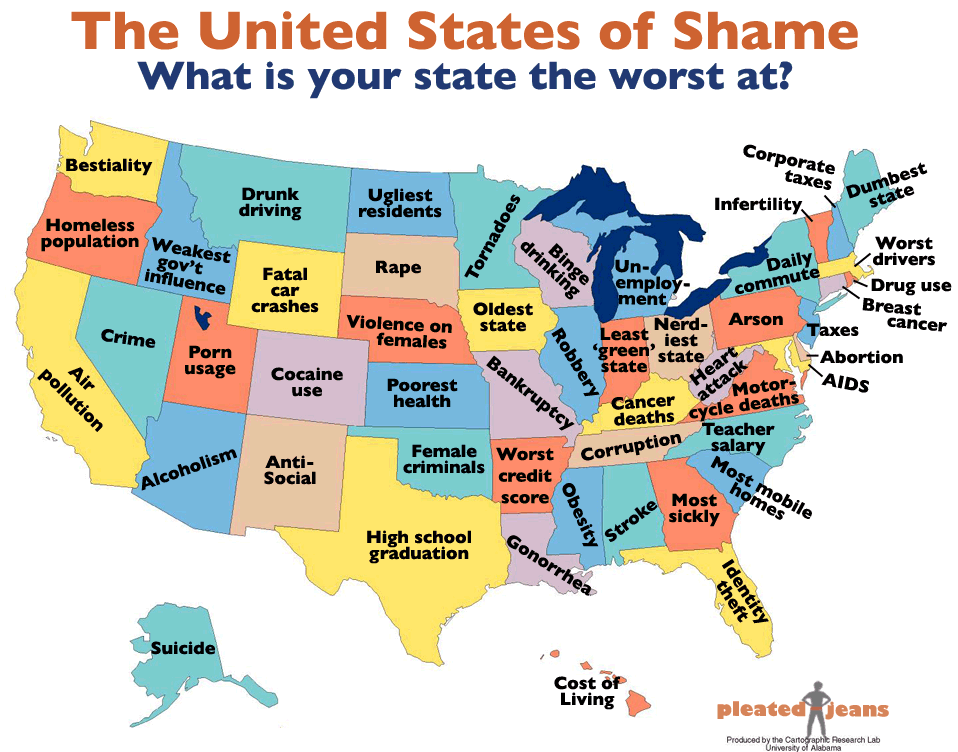
The United States of Shame (CHART)

The United States of Shame (CHART)

Whether it’s a fat population, high rate of STDs or excessive tax rate, it turns out that every state ranks dead last in at least one unsavory category. Check out the map (click image to enlarge) to see what your state is the worst at, then review additional stats and references after the jump:

Rationale and statistics:

Most stats taken from http://www.americashealthrankings.org/ and http://www.census.gov/compendia/statab/rankings.html (unless otherwise noted)

1. Alabama: highest rate of stroke (3.8 percent) (tied with Oklahoma)

2. Alaska: highest suicide rate (23.6 suicides per 100,000 people in 2004)

3. Arizona: highest rate of alcoholism

4. Arkansas: worst average credit score (636)

http://www.talkbusiness.net/article/ARKANSAS-RANKS-LAST-IN-CREDIT-SCORE-AVERAGES/1007/

5. California: most air pollution (15.2 micrograms per cubic meter)

6. Colorado: highest rate of cocaine use per capita (3.9 percent total population)

7. Connecticut: highest rate of breast cancer

http://www.statehealthfacts.org/comparemaptable.jsp?ind=469&cat=10&sub=112&sort=a

8. Delaware: highest abortion rate (27 per 1,000 women aged 15 to 44)

9. Florida: highest rate of identity theft (122.3 reports per 100,000 people)

10. Georgia: sickly based on highest rate of influenza

11. Hawaii –highest cost of living (tied with California)

http://www.cnbc.com/id/38148092/States_With_the_Highest_Cost_of_Living?slide=11

12. Idaho – lowest level of Congressional clout

http://www.newwest.net/topic/article/roll_call_rocky_mountain_states_still_at_bottom_of_congressional_clout_list/C559/L559/

13. Illinois: highest rate of robbery (284.7 incidences per 100,000 people)

14. Indiana: rated the most environmentally unfriendly by NMI solutions

http://www.environmentalleader.com/2010/09/15/indiana-comes-in-last-on-green-state-ranking/

15. Iowa: highest percentage of people age 85 and older (1.8 percent) (tied with three other states)

http://www.statemaster.com/graph/peo_per_of_peo_who_are_85_yea_and_ove-percent-who-85-years-over

16. Kansas: poorest health based on highest average number of limited activity days per month (3.5 days)

http://www.statemaster.com/graph/hea_lim_act_day_per_mon-limited-activity-days-per-month

17. Kentucky: most cancer deaths (227 per 100,000 people) (BONUS fact: Kentucky also has the highest rate of tobacco smokers – 25.6 percent)

18. Louisiana: highest rate of gonorrhea (264.4 reported cases per 100,000 people)

http://www.statemaster.com/graph/hea_gon_rat-health-gonorrhea-rate

19. Maine: dumbest state claim based on lowest average SAT score (1389)

http://www.commonwealthfoundation.org/policyblog/detail/2010-sat-scores-by-state

20. Maryland: highest rate of AIDS diagnosis (27.6 people per 100,000 people)

http://www.avert.org/usa-states-cities.htm

21. Massachusetts: worst drivers claim based on highest rate of auto accidents

http://www.theautochannel.com/news/2002/11/11/150352.html

22. Michigan: highest unemployment rate (13.6 percent)

23. Minnesota: highest number of reported tornadoes (123 in 2010)

http://woodbury.kstp.com/content/minnesota-ranks-first-nation-tornado-reports-2010

24. Mississippi: highest rate of obesity (35.3 percent of total population)

BONUS facts: Mississippi ranks last in the most number of categories. These include highest rate of child poverty (31.9 percent), highest rate of infant mortality (10.3 percent) lowest median household income ($35,078), highest teen birth rate (71.9 per 1,000 women aged 15 to 19) and highest overall rate of STDs.

25. Missouri: highest rate of bankruptcy (700 out of every 100,000 people)

http://www.bcsalliance.com/bankruptcy_statestats.html

26. Montana: highest rate of drunk driving deaths (1.12 deaths per 100 million miles driven)

http://helenair.com/lifestyles/article_c48ad0a6-bce0-5f69-931e-dc5ca0f83583.html

27. Nebraska: highest rate of women murdered annually

28. Nevada: highest rate violent crime (702.2 offenses per 100,000 people). BONUS fact: Nevada also has the highest rate of foreclosure (one in 99 houses)

29. New Hampshire: highest rate of corporate taxes

http://newhampshire.watchdog.org/7194/nh-ranks-last-in-corporate-tax-climate-7th-best-for-business-overall/

30. New Jersey: highest rate of citizen taxation (11.8 percent)

http://retirementliving.com/RLtaxes.html

31. New Mexico: antisocial claim based on lowest ranking in social heath policies

http://www.lasg.org/NMecon05.htm

32. New York: longest average daily commute (30.6 minutes) http://www.statemaster.com/graph/lab_mea_tra_tim_to_wor-labor-mean-travel-time-work

33. North Carolina: lowest average teacher salary

http://www.southernstudies.org/2008/01/north-carolina-ranks-last-for-teacher.html

34. North Dakota: ranked last in ugliest residents report as chosen by The Daily Beast

http://www.thedailybeast.com/galleries/1272/1/?redirectURL=http://www.thedailybeast.com/blogs-and-stories/2010-02-01/the-most-and-least-attractive-states/

35. Ohio: nerdiest state claim based on highest number of library visits per capita (6.9)

http://www.statemaster.com/graph/edu_pub_lib_lib_vis_per_cap-libraries-library-visits-per-capita

36. Oklahoma: highest rate of female incarceration

37. Oregon: highest rate of long-term homeless people

38. Pennsylvania: highest rate of arson deaths (55.56 annually)

http://www.statemaster.com/graph/cri_ars_dea-crime-arson-deaths

39. Rhode Island: highest rate of illicit drug use (12.5 percent of population) http://economix.blogs.nytimes.com/2009/08/11/drug-use-across-the-united-states-or-rhode-island-needs-more-rehab/

40. South Carolina: highest percentage of mobile homes (18.8 percent)

http://www.statemaster.com/graph/hou_per_of_hou_uni_tha_are_mob_hom-housing-percent-units-mobile-homes

41. South Dakota: highest rate of forcible rape 76.5 per 100,000

42. Tennessee: chosen most corrupt state by The Daily Beast

http://www.thedailybeast.com/blogs-and-stories/2010-05-11/the-most-corrupt-states/

43. Texas: lowest high school graduation rate (78.3 percent)

http://www.statemaster.com/graph/edu_hig_sch_dip_or_hig_by_per-high-school-diploma-higher-percentage

44. Utah: highest rate of of online porn subscriptions

http://www.deseretnews.com/article/705288350/Utah-No-1-in-online-porn-subscriptions-report-says.html

45. Vermont: infertility claim based on lowest birth rate of any state (10.6 births per 1,000) (tied with Maine)

http://www.statemaster.com/graph/hea_bir_rat_per_100-birth-rate-per-1-000

46. Virginia: highest number of alcohol-related motorcyle deaths

http://www.vabiker.net/2008/09/virginia-ranks-last-nationally-in-alcohol-related-motorcycle-deaths/

47. Washington: most cases of bestiality (4 reported in 2010)

http://www.pet-abuse.com/pages/cruelty_database/statistics/state_ranking.php?year=2010&search=go

48. West Virginia: highest rate of heart attack (6.5 percent of population)

49. Wisconsin: highest rate of binge drinking (23.2 percent of population)

50. Wyoming: highest rate of deadly car crashes (24.6 deaths per 100,000)

http://www.autoinsurancequotealert.com/news/wyoming-leads-nation-with-highest-motor-vehicle-fatality-rate/

Source

Ohio police shoot man dead after 'domestic killings'

Ohio police shoot man dead after 'domestic killings'

Map

Seven people have been shot dead by a gunman in the north of the US state of Ohio, say reports.

The man, who has not been named, was later shot dead by police in Copley Township near Akron.

The violence is believed to have begun as a family argument - one of the victims was an 11-year-old girl, local media reported.

Five people were shot in one location and then two nearby, Police Chief Michael Mier told Channel 3 News.

One injured person had been taken to hospital, he said. Her condition is not known.

Witnesses told local media that many of the victims were family members of the gunman.

Source

Inspirational Videos - Politics can be discussed in an intelligent manner

Matt Damon Schools Reporter While Defending Teachers


Ben Affleck defends Arabs


The event he's reffering to is here:


Saturday, August 6, 2011

An Anatomy of Addiction: When Two Brilliant Minds Met a "Miracle Drug"

An Anatomy of Addiction: When Two Brilliant Minds Met a "Miracle Drug"

On September 15, 1884, in Heidelberg, Germany, a demonstration took place that electrified the European medical establishment. An audience of distinguished eye surgeons at a medical conference watched as a dog was brought on stage. A doctor squeezed a few drops of a clear liquid into the dog's left eye, leaving its right eye clear. When the doctor waved his forceps in front of the dog's right eye, it naturally flinched. Then the doctor lightly touched his forceps to the surface of the dog's left eye. It didn't even blink.

The audience erupted. They had just witnessed one of the great moments in the history of anesthesia. The wonder drug was cocaine.

It wasn't the cocaine we know today, of course. When we first meet it in the distinguished medical historian Howard Markel's rich, revelatory new book, it's something else entirely. Markel's An Anatomy of Addiction: Sigmund Freud, William Halsted, and the Miracle Drug Cocaine is like the early pages of a family photo album, showing us cocaine as it has not been seen for over 100 years. The drug was pharmaceutically pure enough, to be sure, and plenty potent, but cocaine is now an institution, with its own politics and its own economics and its own malevolent cultural mythology. Back then it was just a novel chemical compound like any other: innocent, newly refined, culturally neutral, stripped of any meaning, its future bright and still full of promise. (See "Amy Winehouse and the Pain of Addiction.")

Of course cocaine wasn't really new. It had been present in the leaves of the coca plant, which grows in the Andes and the Amazon basin, for millennia. Indigenous people there chewed them for a mild buzz, with no ill effects. In some ways the most startling pages of Markel's book are the early passages, where he shows us how Western science took those unremarkable pale green leaves and turned them into a catastrophe. In 1860 a German graduate student figured out how to refine the active component in the leaves into its familiar crystalline form, and it quickly became a fad — a French chemist named Angelo Mariani made a fortune selling it mixed with red wine. His "Vin Mariani" was endorsed by, among others, Queen Victoria, President McKinley, and Pope Leo XIII. (Mariani ultimately lost out to the American claimant Coca-Cola, now available in de-cocainized form.)

But Vin Mariani was a relatively weak solution. The first people who used cocaine in significant quantities and concentrations were, naturally, doctors, and they became its first victims. As it turns out, the drug chose its victims from an exclusive list. One of them was a brilliant American surgeon named William Halsted, who would revolutionize his field. Another was an equally brilliant Viennese doctor named Sigmund Freud. (See a graphic about addiction and the brain.)

In 1884 Freud was a poor and obscure but wildly ambitious young doctor trying to scrape together enough kreutzers to marry his posh fiancée. In his first encounter with cocaine, he used it to try to wean an addicted colleague off of morphine. Freud had no idea how addictive the new drug was, but his friend found out pretty quick: he became dependent on both cocaine and morphine, and he eventually went mad and died. The experience haunted Freud for the rest of his life, but it didn't stop him from continuing to experiment with the wonder drug on himself. In fact, he loved the stuff. "In my last severe depression," he wrote to his fiancée, "I took coca again, and a small dose lifted me to the heights in a wonderful fashion. I am just now collecting the literature for a song of praise to this magical substance." That song would become the monograph Über Coca, Freud's first major publication.

Freud abused cocaine on and off for the next decade, but in the end he was just too tough a bastard for it to kill. Mild cocaine addiction was just one of the many compulsions and obsessions that warred within his personality, and it seems to have gotten shouldered aside in the psychic scrum. Freud also wasn't skilled enough as a clinician to inject himself directly with cocaine solution — he snorted it instead, which gives a milder buzz. In this he differed from the American surgeon Halsted, who didn't get off nearly so easily. (See "Sex Addiction: A Disease or a Convenient Excuse?)

Halsted was the scion of a wealthy New York City family, a Yale man who became an uncommonly masterly and forward-thinking surgeon. In 1884, the same fateful year as Freud, Halsted became interested in cocaine's potential as an anesthetic, and he got his students and colleagues experimenting on themselves. They had no idea what they were dealing with, and at this point Markel's account takes on the mesmerizing quality of an animal attack filmed in slow motion and high resolution, as the rapacious chemistry of the new drug falls on the refined intellectual elite of American medicine and paralyzes and consumes them. "In a matter of weeks," Markel writes, "Halsted and his immediate circle were transformed from an elite cadre of doctors into active cocaine abusers. Tragically, many of the medical students, resident physicians and surgeons who participated in these experiments were decimated by the drug and died early deaths." On May 5, 1885, Halsted himself walked out of an operation — a patient with a gory compound fracture lay in agony in front of him — took a cab to his Manhattan town house, and binged on cocaine for the next seven months.

Markel isn't a flashy writer, nor is he a big thinker. He leaves it to others to make major claims, which he keeps quarantined safely inside quotation marks. (For example, one of Halsted's colleagues attributes Halsted's later success as a surgeon to the discipline and fastidiousness he acquired as a cocaine addict. Markel lets this idea dangle there, suggestively, without endorsing it himself.) But he's a careful writer and a tireless researcher, and as a trained physician himself, Markel is able to pronounce on medical matters with firmness and authority.

In any case, Halsted's story doesn't require a lot of literary flair to lend it power and pathos. He would eventually return to public life, though it was the precarious double life of a high-functioning addict. After a stint in an asylum he rededicated himself to the scalpel; eventually, in spite of his troubled history, he was made the first professor of surgery at the newly formed, massively endowed Johns Hopkins medical school. Halsted hugely rewarded the faith that was placed in him: he more or less created the modern antiseptic operating room, complete with surgical scrubs and rubber gloves, and he pioneered major surgical procedures like the radical mastectomy in the case of breast cancer. But every day for the rest of his life, he retreated to his home at 4:30 in the afternoon to service his addictions to cocaine and, later, morphine, careful calibrating his doses: enough to keep his hands from shaking, not so much that his wits were dulled. He's not the household name Freud is, but he can claim one of the first and greatest second-chance stories of cocaine addiction. He never beat the drug, but he fought it to a draw, at a time when no one even understood what he was fighting.

Source

Israelis stage mass protests over rising living costs

Israelis stage mass protests over rising living costs

Protesters march in Tel Aviv (6 August 2011)
At least 200,000 people marched in Tel Aviv

Related Stories

At least a quarter of a million Israelis have staged marches over the rising cost of living.

The largest protest was in Tel Aviv where police said at least 200,000 people were on the streets, while another 30,000 marched in Jerusalem.

In one of biggest waves of protests in decades in Israel, demonstrators are demanding government action to reduce the cost of housing and food.

Some protesters have also set up camp in city centres.

Police spokesman Micky Rosenfeld that as well as Tel Aviv and Jerusalem, an estimated 20,000 people had taken part in protests in other towns and cities.

"Our numbers are more than 250,000 people across the country," he told AFP news agency.

Israeli media put the number of protesters closer to 300,000.

Analysis

If the Israeli government was hoping this extraordinary movement of middle-class protesters was losing momentum and direction, the message from the streets of Tel Aviv, Jerusalem and other cities across the country is that they are not giving up.

The unaffordability of housing, childcare and even some basic foods has driven many Israelis to despair in a country with high prices but relatively low salaries.

Thus far, Prime Minister Netanyahu has promised to reassess his government's priorities and make housing more affordable. But, until they see more immediate and concrete proposals, thousands of protesters say they will remain camped out in the heart of Tel Aviv.

It was the third Saturday of protests in a row.

The BBC's Wyre Davies in Jerusalem says most of those taking part were middle-class professionals who say their salaries cannot cover basic expenses including housing and childcare.

The protesters have been inspired by social uprisings in the Middle East but instead of seeking political change are demanding that the government take action over the soaring cost of living, he adds.

"It's hard to live in this country," said 26-year-old student Ehud Rotem, who joined the Jerusalem protest.

He told AP news agency that Israelis perform their mandatory military service, work and pay high taxes but "still don't earn enough to finish the month".

Another 45-year-old Tel Aviv resident said the situation was "impossible".

"We work so hard and we cannot afford a quiet life, we always have to struggle."

A revolution'

One of the organisers, 33-year-old Baroch Oren, said the movement was "a revolution".

"There has been nothing like this for decades - all these people coming together, taking to the streets, demanding change."

Israel's annual economic growth is relatively healthy, averaging 4.5% since 2004, and in the same period unemployment has fallen from about 11% to 6%.

But the public say this growth has failed to benefit them and there is growing public anger over perceived social inequality, injustice and official corruption.

Israeli PM Benjamin Netanyahu (1 Aug 2011) Mr Netanyahu has promised to tackle issues including the high cost of housing

Prime Minister Benjamin Netanyahu has promised to reassess his priorities and make housing more affordable.

Mr Netanyahu's spokesman, Mark Regev, told the BBC's Newshour programme that the government was aware it had to act to bring down prices of housing and consumer products.

"we are hopeful that this current wave of demonstrations will help us get through the parliament the sort of legislation and things we require to bring down prices," he said.

He said a team of ministers, academic experts and business people would be appointed on Sunday to meet in "a round table type situation".

He added that Mr Netanyahu was prepared to meet protesters.

Source

Auditor slams Delhi Commonwealth Games preparations

Auditor slams Delhi Commonwealth Games preparations

A crane lifts debris from a pedestrian bridge that collapsed outside the Jawaharlal Nehru Stadium (22 September 2010)
India was deeply embarrassed by the construction delays, budget overruns and corruption allegations

Related Stories

India's state auditor says preparations for last year's Commonwealth Games were deeply flawed, riddled with favouritism and vastly over budget.

A report for parliament said there were serious irregularities with bidding and contracts, and that the seven years organisers had to prepare were wasted.

The games cost $4.1bn (£2.5bn) instead of the $270m (£166m) first estimated, while revenue was only $38m (£23m).

The head of the organising committee is already in jail on corruption charges.

Law Minister Salman Khursheed said parliament would reflect on the report and "decide what needs to be done".

Suresh Kalmadi's appointment, on the recommendation of the prime minister's office despite objections from the then-sports minister, was also criticised in the auditor's report.

Due diligence 'conspicuously absent'

India's government had hoped hosting the 2010 Commonwealth Games in Delhi would showcase its status as an emerging global power, but it was instead deeply embarrassed by construction delays, budget overruns and corruption allegations.

The Comptroller and Auditor General of India's report concluded that the root of the organisers' problems were the model of governance set up in 2003, in which "authority was dissipated, accountability was defused and unity of command was not provided for or followed".

Timeline: Games scandal

  • October 2010: Games held in Delhi after weeks of problems and construction delays - corruption probe begins soon after
  • November 2010: Games Chairman Suresh Kalmadi resigns his post in the Congress party
  • November 2010: Officials TS Darbari, Sanjay Mohindroo and Games treasurer M Jayachandran arrested over alleged financial irregularities
  • January 2011: Suresh Kalmadi and Games secretary general Lalit Bhanot sacked
  • February 2011: Mr Bhanot and top official VK Verma arrested
  • March 2011: Head of India's anti-corruption watchdog forced to resign
  • April 2011: Suresh Kalmadi arrested

Huge amounts of public money were placed at the disposal of non-government officials unwilling to heed advice from civil servants.

"The modus operandi observed over the entire gamut of activities leading to the conduct of the games was: inexplicable delays in decision making, which put pressure on timelines and thereby led to the creation of an artificial or consciously created sense of urgency," the report said.

"Since the target date was immovable, such delays could only be overcome by seeking, and liberally granting, waivers laid down in government procedures."

Many contracts were awarded after single bids, while some were handed out on a "nomination basis", without any competition.

The exorbitant rates charged by contractors to counter the delays caused huge financial loss to the organising committee and the government.

At the same time, the federal and local governments failed to examine the organising committee's proposals, budgets and actions.

"Appropriate due diligence was conspicuously absent at all levels."

The report said the contract for a timing, scoring and results system was awarded to Swiss timing company, Omega SA, after a rival, MSL Spain, was disqualified irregularly. The contract for building the athletes' village was handed to Emaar MGF Constructions on the basis of a single bid.

Delhi's state government was also accused of wasting at least $29m with its "ill-conceived and ill-planned" plan to beautify the city before the games, including spending $7.7m extra on foreign-made street lighting.

This revelation led to the opposition Bharatiya Janata Party (BJP) to demand the immediate resignation of Delhi Chief Minister, Sheila Dikshit.

Ms Dikshit rejected the demand but said she would co-operate fully with the parliamentary committee which will investigate the audit report.

Source

Wednesday, August 3, 2011

Debt ceiling resolution


Cuts for the Poor, no tax raises.

Essentially this is a slap in the face to Shared Sacrifice.

What has happened to the equity and fair treatment of all people?

Fukushima...what you haven't been hearing and why - Why Nuclear Energy Sucks

Sunday, July 31, 2011

Pollinators lured away by farmland, study shows

Pollinators lured away by farmland, study shows

Hoverfly on a hawthorn flower (Image: BBC) The researchers say their findings could be applied to habitats around the globe

Related Stories

A study has challenged the idea that areas such as farmland provide pollinating insects with a "corridor" between fragmented habitats.

Researchers suggested that the pollinators in their survey were "fickle foragers" and would concentrate on areas rich in pollen and nectar.

The team warned that these behaviour could have an impact on rare native plants that are pollinated by insects.

The findings have been published in the journal Current Biology.

The team of researchers from Oxford University and Earthwatch UK said their findings were a surprise, as the result challenged the long-held assumption that areas that were rich in resources would encourage the movement of pollinators from one group of native trees to another.

However, they added, it actually created a barrier effect for non-specialist feeders.

"Looked at from an insect's point of view, it makes sense," explained co-author David Boshier.

"These insects are not trying to pollinate a particular species of tree, they are just foraging. So if they leave a patch of native forest and fly across farmland which happens to be rich in resources, they are likely to collect pollen and nectar there rather than carry on to another patch of native forest."

However, Dr Boshier added: "Conversely, areas of sparse resources - such as (conifer) plantations - have less to offer so the pollinators are more likely to continue their journey and reach other patch of the native forest."

Pollination patterns

The researchers focused their attention on the pollination of Gomortega keule, an endangered species of tree whose natural stands only survive in patches of native forest in central Chile.

Gomortega keule, listed as Endangered (Image: Tonya Lander) The study warns disruption to pollinators' behaviour could threaten Gomortega keule's long-term survival

The trees' primary pollinators are hoverflies. By sampling seeds, the team was able to develop an understanding of how pollen was transported across the study area.

"If you can imagine about 900 trees, and all of the potential connections between those trees, then you end up with a lot of data regarding where pollinators are moving or not moving," explained co-author Dr Tonya Lander.

"We used that data to build a model and, on average, these look like the patterns that are emerging," she told BBC News.

"In general, there was more pollination happening when trees are separated by tree plantations, and less pollination happening when the trees were separated by agricultural land."

The team explained that they decided to call this effect the Circe Principle, after a nymph in Homer's Odyssey who seduced Odysseus on his journey home from his adventures.

Another member of the team, Dan Bebber from Earthwatch, said: "This study shows that new landscape models need to take into account the positive contributions and benefits of landscapes defined as 'non-habitat', as well as how best they can be managed.

"Our results identify possible actions to improve the interactions of landscapes of endangered species such as G. keule, and other species pollinated by common insects."

The team now hope to carry out further studies to test whether the Circe Principle applies to other environments.

Source