Showing posts with label Graphics. Show all posts

Thursday, March 8, 2012

Single molecule's electric charges seen in first image

Single molecule's electric charges seen in first image

Experimental and theoretical representation of charge distributions (IBM Research)
The team's first-ever charge distribution measurements (top) matched neatly with theory

Related Stories

Researchers have shown off the first images of the "charge distribution" in a single molecule, showing an intricate dance of electrons at tiny scales.

Charges on single atoms have been measured before, but capturing the dance within a complex molecule is significantly more difficult.

The pioneering measurement could shed light on a range of "charge-transfer" processes that are common in nature.

Details are reported in the journal Nature Nanotechnology.

The work comes from a group at IBM Research Zurich that specialises in examining the world at the infinitesimal scale of atoms and molecules.

The same team is responsible for the measurement of charge on single atoms, as well as the first image of a single molecule - in a sense the new work is a combination of those two views.

However, it makes use of a different technique, called Kelvin probe microscopy. It is a variant of the atomic force microscopy that allowed the first molecular image in 2009.

It requires a tiny bar just billionths of a metre across and with a sharp tip that ends in a single small molecule. This bar, or cantilever, is held at a small voltage while it is scanned across the surface of a much larger, X-shaped molecule, naphthalocyanine.

As the charged tip encounters charges within the naphthalocyanine, the cantilever begins wagging in a way that shows up precisely where the electrons are.

The trick of naphthalocyanine, though, is that by applying a voltage to the molecule directly, two hydrogen atoms at its centre swap places, and the electrons reshuffle to opposite arms of the "X".

With the team's technique, they were able to observe this change in charge distribution.

In combination with more established techniques, the approach will shed light on the nanoscale world that is promising not only for fundamental science, but also for future applications in which electric behaviour at such scales will be exploited.

"It will now be possible to investigate at the single-molecule level how charge is redistributed when individual chemical bonds are formed between atoms and molecules on surfaces," said lead author of the research Fabian Mohn.

"This is essential as we seek to build atomic and molecular scale devices."

Source

Thursday, February 2, 2012

Science meets art in annual contest

In pictures: Science meets art in annual contest

Thursday, January 12, 2012

World's smallest frog discovered

World's smallest frog discovered

Frog on coin
The tiny frog sits easily on a US dime, whose diameter is 18mm

A frog species that appears to be the world's smallest has been discovered in Papua New Guinea by a US-based team.

At 7mm (0.27 inches) long, Paedophryne amauensis may be the world's smallest vertebrate - the group that includes mammals, fish, birds and amphibians.

The researchers also found a slightly larger relative, Paedophryne swiftorum.

Presenting the new species in PLoS One journal, they suggest the frogs' tiny scale is linked to their habitat, in leaf litter on the forest floor.

What are amphibians?

Frog eye
  • First true amphibians evolved about 250 million years ago
  • Three orders: frogs (inc. toads), salamanders (inc. newts) and the limbless caecilians
  • Adapted to many aquatic and terrestrial habitats
  • Present on every continent except Antarctica
  • Many metamorphose from larvae to adults

Finding the frogs was not an easy assignment.

They are well camouflaged among leaves on the forest floor, and have evolved calls resembling those of insects, making them hard to spot.

"The New Guinea forests are incredibly loud at night; and we were trying to record frog calls in the forest, and we were curious as to what these other sounds were," said research leader Chris Austin from Louisiana State University in Baton Rouge, US.

"So we triangulated to where these calls were coming from, and looked through the leaf litter.

"It was night, these things are incredibly small; so what we did after several frustrating attempts was to grab a whole handful of leaf litter and throw it inside a clear plastic bag.

"When we did so, we saw these incredibly tiny frogs hopping around," he told BBC News.

Littering the leaves

The Paedophryne genus was identified only recently, and consists of a number of tiny species found at various points in the eastern forests of Papua New Guinea.

Frog limbs The tiny limbs of amauensis (top) and swiftorum are rendered translucent

"They're occupying the relatively thick leaf litter of tropical forest in low-lying parts of the island, eating incredibly small insects that typically are much smaller than insects that frogs eat," said Professor Austin.

"And they're probably prey for a large number of relatively small invertebrates that don't usually prey on frogs."

Predators may well include scorpions.

Intriguingly, other places in the world that also feature dense, moist leaf litter tend to possess such small frog species, indicating that amphibians are well placed to occupy this ecological niche.

Before the Paedophrynes were found, the title of "world's smallest frog" was bestowed on the Brazilian gold frog (Brachycephalus didactylus) and its slightly larger Cuban relative, the Monte Iberia Eleuth (Eleutherodactylus iberia). They both measure less than 1cm long.

The smallest vertebrates have until now been fish.

Adult Paedocypris progenetica, which dwells in Indonesian swamps and streams, measure 7.9-10.3 mm long.

Male anglerfish of the species Photocorynus spiniceps are just over 6mm long. But they spend their lives fused to the much larger (50mm long) females, so whether they should count in this contest would be disputed.

Paedophryne amaunensis adults average 7.7mm, which is why its discoverers believe it how holds the crown.

The remote expanses of Papua New Guinea rank alongside those of Madagascar as places where hitherto undiscovered amphibian species are expected to turn up, as they are largely undeveloped and not well explored.

Source

Monday, January 9, 2012

Leopard in deadly attack in Indian city of Guwahati

Leopard in deadly attack in Indian city of Guwahati

Wild leopard attacks man in Gauhati (07/01/12)
One of the victims, Kripesh Dey, was badly injured in the attack

Related Stories

One person has been killed and several others injured in an attack by a leopard in the Indian state of Assam.

The man died after the leopard attacked several people in a densely populated area of the city of Guwahati.

The leopard strayed into the Shilpukhuri area of the city on Saturday and attacked residents, one of whom died the next day of his injuries.

The animal has now been released into the Manas Wildlife Sanctuary, forest officials said.

For the people of Guwahati, bomb blasts and other terror attacks were not uncommon till recently, because of repeated attacks by the secessionist United Liberation Front of Assam (Ulfa), but a leopard straying into a town is rare, particularly during the day.

Chased out

The leopard was first sighted on Saturday morning near a crematorium in the town.

As the funeral of a Congress Party leader's son was going on, the place was full of dignitaries, ministers and other VIPs.

Police sent them to a safer place and chased the leopard out, but it turned towards the Shilpukhuri residential area.

"First, it jumped across several multi-storey buildings, including a bank, then jumped on to the ground," said Manas Paran, photojournalist for the Sunday Indian magazine and an eyewitness.

Local people armed with sticks and iron rods tried to chase the leopard away. The enraged animal then started attacking locals, Mr Paran told BBC.

Mr Paran kept following the big cat at extremely close quarters to get good pictures for his magazine.

Deb Kumar Das, aged around 50, was one of the first people whom the leopard clawed at. He suffered severe wounds to the head, ear and neck.

He was treated in hospital but later returned home, where he was found dead on Sunday.

Several others suffered the ire of the big cat. One of them, Kripesh Dey, had part of his scalp removed in the attack.

Later, when the leopard entered a shop, locals locked it up. Forest officials and vets reached the scene after some time with tranquilisers and were able to capture it.

"After it was tranquilised and treated in Guwahati Zoo, we released it in the Manas Wildlife Sancturary today", said Utpal Borah, head of the zoo.

This incident has once again brought to fore the conflict between humans and animals in India.

Assam's forest officials say humans are encroaching onto leopard habitats. Residential areas built right in leopard habitats have become vulnerable to such attacks.

This is the second death from leopard attacks in five years.

Source

Friday, October 28, 2011

Scott Olsen - You Did this to My Brother


" Marines around the world are outraged by the injuries inflicted by police on Scott Olsen at Tuesday's Occupy Oakland protests.

Olsen is in a medically-induced coma after getting hit in the head by a police projectile.

http://www.businessinsider.com/this-veteran-could-be-th...


The following picture is taken from the Reddit thread "How I feel, as a United States Marine, about what occurred in Oakland."

http://www.reddit.com/r/occupywallstreet/comments/lqjx2... /


This man is not alone. In the five hours since the thread went up there have been over 600 comments.


http://www.businessinsider.com/marine-to-police-you-did...


Wednesday, September 28, 2011

Fossil beetles show true colours

Fossil beetles show true colours

Tiger beetle
Beetles' great abundance today and in the fossil record makes them key environmental indicators

Related Stories

At their brilliant best, the colours of beetles can make the insects look like they are made of some precious metal.

But when these beetles die and become fossilised, how much of that iridescent beauty is preserved?

It is a question that has been puzzling Dr Maria McNamara from Yale University.

Her microscopic study of ancient beetles has shown how any retained colours will be subtly altered. Blues in life will become greens in death, it seems.

It is a fascinating observation because it means scientists can say with greater confidence what a creature really looked like millions of years ago.

And that colour information could be very revealing about the way a particular beetle lived its life.

"These kinds of colours have lots of visual functions," explained Dr McNamara, who is also affiliated with University College Dublin.

"They might function in communication, for example, or in thermo-regulation. And so it's important to be able to reconstruct them properly so that we can say what those organisms were using the colours for in the first place," she told BBC News.

The spectacular colours we see in many beetles are the result of the way light interacts with the very fine layers of material that make up their cuticle, or exoskeleton.

Fabulously small structures in this chitin material will bend and reflect light to enhance particular wavelengths.

Dr McNamara and her colleagues examined the cuticles of a variety of fossil beetles ranging in age from 15 to 47 million years old.

A 40 million-year-old fossil chrysomelid beetle This 40-million-year-old leaf beetle would have looked less blue and more violet in life

The team used powerful analytical tools such as electron microscopes to determine how the light-controlling properties in these ancient remains had been affected by the process of fossil preservation, in which the atoms and molecules of tissues can be removed or replaced.

What the group found was that the structures were still present but that their chemistry, not unexpectedly, had been changed.

And the consequence of this chemistry alteration was to "redshift" colours to longer wavelengths. A live violet-coloured beetle would look blue when fossilised; a blue one would take on a green hue after being buried in the ground for millions of years, and so on.

"What actually happens is - the refractive index of the cuticle changes," explained Dr McNamara.

"This is a measure of how much the light is bent. This means the chemistry must have changed because the refractive index in a material will depend on what it's made from."

The researcher cautions that the degree of redshifting differed slightly from specimen to specimen, and that the beetles her team studied all came from similar lake sediments. Other types of sediment might show different results, she added.

Leaf beetles
The team now has a method to reconstruct the true colours of beetles

Source

Whose bright idea was that? Border between India and Pakistan is so brightly lit it can be seen from space

Whose bright idea was that? Border between India and Pakistan is so brightly lit it can be seen from space

By Chris Parsons

Snaking for hundreds of miles across the earth's surface, this spectacular picture shows one of the planet's land borders like never before.

The dramatic picture shows a bright orange line jutting across the earth, indicating the border between India and Pakistan.

The stunning image of the earth, taken from the International Space Station last month, also shows busy cities show up as bright clusters hundreds of miles apart.

Spectacular: The International Space Station image captures the floodlit border between India and Pakistan in amazing detail

Spectacular: The International Space Station image captures the floodlit border between India, above the orange line, and Pakistan, below the border in the picture

The border between India and Pakistan, shown here on a conventional satellite image, is now under heavy surveillance through floodlights and fencing

The border between India and Pakistan, shown here on a conventional satellite image, is now under heavy surveillance through floodlights and fencing

The Indian government sanctioned a move to erect floodlights along the terrain separating India and Pakistan in the Gujarat sector in 2003 to prevent smuggling and arms trafficking.

In previous years the border has regularly seen attempts at infiltration by terrorists, as well as the smuggling of arms, ammunition and contraband.

In total, the Indian government hope to cover 1248 miles (2009 km) of the 1800-mile (2900 km) India-Pakistan border with floodlights.

Officials have so far erected floodlights along 286 miles (460 km) of Indian border with the Pakistan state of Punjab.

The extensive floodlighting continues for 635 miles (1022 km) across Rajasthan, 109 miles (176 km) across the Jammu international border, and 125 miles (202 km) through Gujarat.

So far 1156 miles (1861 km) of the border have been floodlit.

Plans are in place to erect a total 1269 miles (2043 km) of fencing along the nation's border.

The Indian government hope to have completely finished the floodlight operation by March 2012.

A similar fenced border zone operates along India's eastern border with Bangladesh, although it cannot be seen as vividly on images like this.

The Gujarat border region was notorious for being infiltrated until officials erected the floodlit border in 2003.

The spectacular image showing the floodlit border was taken by Expedition 28 International Space Station Crew on August 21.

Also visible on the picture as bright clusters is Lahore, Pakistan, nearest to the orange border line.

Islamabad, Pakistan, can also be seen towards the bottom of the picture, as well as New Delhi, India, at the top.

The floodlit border fencing built through the Indian government since 2003 is so bright it can be seen from space

The floodlit border fencing built through the Indian government since 2003 is so bright it can be seen from space


Tuesday, September 6, 2011

Probe pictures Moon landing sites

Probe pictures Moon landing sites

Apollo 17 landing site
Apollo 17: The wheels of the Lunar Roving Vehicle ("Moon buggy") left parallel lines in the "soil"

Related Stories

Remarkable new images of the Apollo landing sites on the Moon have been released by Nasa.

The pictures clearly show the hardware left on the lunar surface by American astronauts in the 1960s and 70s, including Apollo 17's "Moon buggy".

The images were acquired by the robotic Lunar Reconnaissance Orbiter (LRO), which has been circling Earth's satellite since 2009.

Such shots have been returned before, but these are the best yet.

LRO has recently lowered its orbit from 50km above the Moon's surface to just 25km.

This makes it easier to see equipment, such as the descent stages that put the astronauts on the surface. Some of the science experiments are visible, also - as are the trails of bootmarks left in the dirt as the crews positioned these science packages.

LRV Apollo 17 Harrison Schmitt sits in the LRV

The Apollo 17, 14 and 12 sites are the focus of the latest release.

They were viewed by the narrow-angle imaging system on LRO's Lunar Reconnaissance Orbiter Camera (LROC) instrument.

At the lower altitude, this instrument sees objects at a resolution of 25cm by 25cm per pixel.

In an extreme blow-up of the Apollo 17 Lunar Roving Vehicle (LRV), it is just possible to discern the condition in which the astronauts Eugene Cernan and Harrison Schmitt parked the buggy - with its wheels turned to the left.

LRO has been a highly productive mission. It has now returned several hundred thousands pictures of the lunar surface.

The probe was originally conceived as a robotic precursor to future manned missions. However, when Nasa might return to the lunar body with astronauts is not clear. Last year, US politicians cancelled the project, known as Constellation, that was intended to achieve this feat.

"We all like to obsess and look at the Apollo landing site images because it's fun," said Mark Robinson, the LROC principal investigator from Arizona State University, Tempe.

LRO artist's impression LRO was launched in 2009

"People actually used to be able to go to the Moon; people used to explore the Moon - and hopefully sometime in the future that will continue again. But LROC is looking at the whole Moon and we've taken about 1,500 of these high-resolution images distributed all around the Moon… and this is just a huge resource for anybody studying the Moon, doing science; and engineers planning to go back to the Moon in general and to specific sites."

Erosion processes on the Moon work much slower than on an active planet like Earth. Eventually, though, all traces of the Moon landings will be erased.

The lunar body is constantly bombarded by micrometeorites that will, in time, mix up the boottracks and break down the equipment. It has been estimated that rock at the surface erodes at a rate of about 1mm per million years.

"In human years, it may seem like forever, but in geologic terms probably there will be no traces of the Apollo exploration in let's say 10 to 100 million years," said Dr Robinson.

On Thursday, Nasa will launch its latest Moon mission - the Gravity Recovery and Interior Laboratory (Grail).

This is a pair of satellites that will survey the Moon's gravity in unprecedented detail. The data will reveal its internal structure, helping to explain how the lunar body formed and why its nearside now looks so different from its farside.

Source

Monday, August 8, 2011

Sunday, August 7, 2011

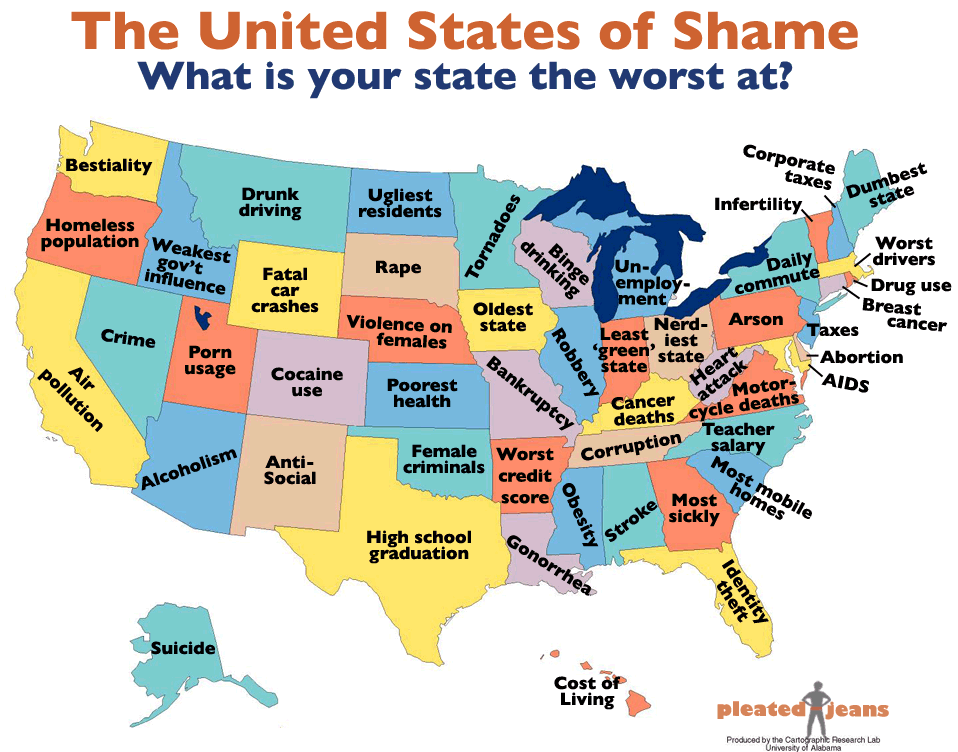
The United States of Shame (CHART)

The United States of Shame (CHART)

Whether it’s a fat population, high rate of STDs or excessive tax rate, it turns out that every state ranks dead last in at least one unsavory category. Check out the map (click image to enlarge) to see what your state is the worst at, then review additional stats and references after the jump:

Rationale and statistics:

Most stats taken from http://www.americashealthrankings.org/ and http://www.census.gov/compendia/statab/rankings.html (unless otherwise noted)

1. Alabama: highest rate of stroke (3.8 percent) (tied with Oklahoma)

2. Alaska: highest suicide rate (23.6 suicides per 100,000 people in 2004)

3. Arizona: highest rate of alcoholism

4. Arkansas: worst average credit score (636)

http://www.talkbusiness.net/article/ARKANSAS-RANKS-LAST-IN-CREDIT-SCORE-AVERAGES/1007/

5. California: most air pollution (15.2 micrograms per cubic meter)

6. Colorado: highest rate of cocaine use per capita (3.9 percent total population)

7. Connecticut: highest rate of breast cancer

http://www.statehealthfacts.org/comparemaptable.jsp?ind=469&cat=10&sub=112&sort=a

8. Delaware: highest abortion rate (27 per 1,000 women aged 15 to 44)

9. Florida: highest rate of identity theft (122.3 reports per 100,000 people)

10. Georgia: sickly based on highest rate of influenza

11. Hawaii –highest cost of living (tied with California)

http://www.cnbc.com/id/38148092/States_With_the_Highest_Cost_of_Living?slide=11

12. Idaho – lowest level of Congressional clout

http://www.newwest.net/topic/article/roll_call_rocky_mountain_states_still_at_bottom_of_congressional_clout_list/C559/L559/

13. Illinois: highest rate of robbery (284.7 incidences per 100,000 people)

14. Indiana: rated the most environmentally unfriendly by NMI solutions

http://www.environmentalleader.com/2010/09/15/indiana-comes-in-last-on-green-state-ranking/

15. Iowa: highest percentage of people age 85 and older (1.8 percent) (tied with three other states)

http://www.statemaster.com/graph/peo_per_of_peo_who_are_85_yea_and_ove-percent-who-85-years-over

16. Kansas: poorest health based on highest average number of limited activity days per month (3.5 days)

http://www.statemaster.com/graph/hea_lim_act_day_per_mon-limited-activity-days-per-month

17. Kentucky: most cancer deaths (227 per 100,000 people) (BONUS fact: Kentucky also has the highest rate of tobacco smokers – 25.6 percent)

18. Louisiana: highest rate of gonorrhea (264.4 reported cases per 100,000 people)

http://www.statemaster.com/graph/hea_gon_rat-health-gonorrhea-rate

19. Maine: dumbest state claim based on lowest average SAT score (1389)

http://www.commonwealthfoundation.org/policyblog/detail/2010-sat-scores-by-state

20. Maryland: highest rate of AIDS diagnosis (27.6 people per 100,000 people)

http://www.avert.org/usa-states-cities.htm

21. Massachusetts: worst drivers claim based on highest rate of auto accidents

http://www.theautochannel.com/news/2002/11/11/150352.html

22. Michigan: highest unemployment rate (13.6 percent)

23. Minnesota: highest number of reported tornadoes (123 in 2010)

http://woodbury.kstp.com/content/minnesota-ranks-first-nation-tornado-reports-2010

24. Mississippi: highest rate of obesity (35.3 percent of total population)

BONUS facts: Mississippi ranks last in the most number of categories. These include highest rate of child poverty (31.9 percent), highest rate of infant mortality (10.3 percent) lowest median household income ($35,078), highest teen birth rate (71.9 per 1,000 women aged 15 to 19) and highest overall rate of STDs.

25. Missouri: highest rate of bankruptcy (700 out of every 100,000 people)

http://www.bcsalliance.com/bankruptcy_statestats.html

26. Montana: highest rate of drunk driving deaths (1.12 deaths per 100 million miles driven)

http://helenair.com/lifestyles/article_c48ad0a6-bce0-5f69-931e-dc5ca0f83583.html

27. Nebraska: highest rate of women murdered annually

28. Nevada: highest rate violent crime (702.2 offenses per 100,000 people). BONUS fact: Nevada also has the highest rate of foreclosure (one in 99 houses)

29. New Hampshire: highest rate of corporate taxes

http://newhampshire.watchdog.org/7194/nh-ranks-last-in-corporate-tax-climate-7th-best-for-business-overall/

30. New Jersey: highest rate of citizen taxation (11.8 percent)

http://retirementliving.com/RLtaxes.html

31. New Mexico: antisocial claim based on lowest ranking in social heath policies

http://www.lasg.org/NMecon05.htm

32. New York: longest average daily commute (30.6 minutes) http://www.statemaster.com/graph/lab_mea_tra_tim_to_wor-labor-mean-travel-time-work

33. North Carolina: lowest average teacher salary

http://www.southernstudies.org/2008/01/north-carolina-ranks-last-for-teacher.html

34. North Dakota: ranked last in ugliest residents report as chosen by The Daily Beast

http://www.thedailybeast.com/galleries/1272/1/?redirectURL=http://www.thedailybeast.com/blogs-and-stories/2010-02-01/the-most-and-least-attractive-states/

35. Ohio: nerdiest state claim based on highest number of library visits per capita (6.9)

http://www.statemaster.com/graph/edu_pub_lib_lib_vis_per_cap-libraries-library-visits-per-capita

36. Oklahoma: highest rate of female incarceration

37. Oregon: highest rate of long-term homeless people

38. Pennsylvania: highest rate of arson deaths (55.56 annually)

http://www.statemaster.com/graph/cri_ars_dea-crime-arson-deaths

39. Rhode Island: highest rate of illicit drug use (12.5 percent of population) http://economix.blogs.nytimes.com/2009/08/11/drug-use-across-the-united-states-or-rhode-island-needs-more-rehab/

40. South Carolina: highest percentage of mobile homes (18.8 percent)

http://www.statemaster.com/graph/hou_per_of_hou_uni_tha_are_mob_hom-housing-percent-units-mobile-homes

41. South Dakota: highest rate of forcible rape 76.5 per 100,000

42. Tennessee: chosen most corrupt state by The Daily Beast

http://www.thedailybeast.com/blogs-and-stories/2010-05-11/the-most-corrupt-states/

43. Texas: lowest high school graduation rate (78.3 percent)

http://www.statemaster.com/graph/edu_hig_sch_dip_or_hig_by_per-high-school-diploma-higher-percentage

44. Utah: highest rate of of online porn subscriptions

http://www.deseretnews.com/article/705288350/Utah-No-1-in-online-porn-subscriptions-report-says.html

45. Vermont: infertility claim based on lowest birth rate of any state (10.6 births per 1,000) (tied with Maine)

http://www.statemaster.com/graph/hea_bir_rat_per_100-birth-rate-per-1-000

46. Virginia: highest number of alcohol-related motorcyle deaths

http://www.vabiker.net/2008/09/virginia-ranks-last-nationally-in-alcohol-related-motorcycle-deaths/

47. Washington: most cases of bestiality (4 reported in 2010)

http://www.pet-abuse.com/pages/cruelty_database/statistics/state_ranking.php?year=2010&search=go

48. West Virginia: highest rate of heart attack (6.5 percent of population)

49. Wisconsin: highest rate of binge drinking (23.2 percent of population)

50. Wyoming: highest rate of deadly car crashes (24.6 deaths per 100,000)

http://www.autoinsurancequotealert.com/news/wyoming-leads-nation-with-highest-motor-vehicle-fatality-rate/

Source

Sunday, March 13, 2011

Time.com Cartoons of the Week

Cartoons of the Week


Political cartoons

Political cartoons


Political cartoons


Political cartoons


Political cartoons


Political cartoons


Political cartoons


Political cartoons

Political cartoons

Political cartoons

Political cartoons


I love keeping up to date with these witty cartoons. Keep track of them at:
http://www.time.com/time/cartoonsoftheweek/

Thursday, January 6, 2011

Kodachrome last remaining film roll developed in Kansas

Kodachrome last remaining film roll developed in Kansas

Kodachrome ad Kodachrome was the first commercial film to successfully shoot in colour

Related stories

The final roll of Kodachrome film, a widely-lauded quality colour film, is to be developed in Kansas on Thursday.

Kodak announced it was discontinuing the iconic film in 2009, after competition from digital cameras caused a large sales decline.

Kodachrome is difficult to process, requiring expert handlers, and Dwayne's Photo in Kansas is the sole remaining developer.

The last film to be developed was shot by the owner, Dwayne Steinle.

Kodachrome film is renowned for its exceptional rendering of colour, vivid images and archival longevity. For many years, it was the preferred brand for print media.

Created in 1935, it was the first commercial film to successfully shoot in colour.

Kodachrome was also used for motion pictures.

Dwayne's Photo has been inundated with requests for developing, many from photographers who had been hoarding the coveted film for years.

One customer picked up 1,580 rolls of film used solely to shoot railroad engines. The nearly 50,000 slides cost $15,798 (£10,200) to develop.

BBC photo editor Phil Coomes has been documenting his own final days with Kodachrome, as well as collecting reader photographs on his BBC blog.

Afghan Girl
Sharbat Gula, Afghan Girl, at Nasir Bagh refugee camp near Peshawar, Pakistan, 1984. The Afghan Girl photo is recognized around the world (Courtesy of Steve McCurry/Magnum Photos)

One of Kodachrome's most famous admirers is National Geographic's Steve McCurry, the photojournalist who captured the world's attention with a haunting 1984 cover photograph of Sharbat Gula, an Afghan refugee girl with stunning green eyes.

Ms Gula, whose identity remained unknown for many years, did not see the image until a documentary film crew located her in 2003.

Although Mr Steinle developed his own Kodachrome roll last, Kodak gave the final roll it produced to Mr McCurry.

With just 36 frames to use, he travelled to India to photograph a tribe on the verge of extinction.

Mr McCurry also shot images of New York, Kansas and actor Robert DeNiro in a journey filmed as a documentary by National Geographic.

He hand-delivered the last roll to Dwayne's Photo earlier this year.

"I wasn't going to take any chances," he told the New York Times.

The National Geographic film is likely to air in spring 2011.

Source


Also a similar good read on time:

PhotoJournalism at the Crossroads

Wednesday, December 15, 2010

Economic Downturn, Financial Rescues, and Legacy of Bush Era Policies Drive Record Deficits


Source

We are not in this mess because of Social Security, which has a 2 trillion dollar Surplus.

We are not in this mess because of Medicare/Medicaid, because far too few people are covered under these programs.

We are in this mess because of Defense spending(wars), Tax cuts, and Bailouts.

They are the real Axis of Evil.

Jason Linkins Jason Linkins jason@huffingtonpost.com | HuffPost Reporting Become a Fan Get Email Alerts from this Reporter Roger Simon Whines About T

Roger Simon Whines About The 'Class Warfare' That The Top One Percent Decisively Won Years Ago

People who live outside the Beltway may not be aware of the fact that in Washington, DC, we have a local competition to see who can write the most shallow, cotton-headed thing about politics. That competition is known locally as "Politico," and today, the 2010 contest appears to have been won by Roger Simon, who has penned what, for all intents and purposes, is a tone-poem to pure inanity.

The rich are different from you and me. They are swine.

So begins this piece, written by someone who is doing a lot better in this economy than say, many of the people who will show up in this forthcoming book, about the economic realities in America. Simon goes on to paint a strange picture of what's been going on in the Congressional debates of the past year:

So say many of the Democrats in the House of Representatives who would rather that jobless people lose their unemployment checks and middle-class people lose their income tax breaks than that the rich get a dime extra.

What Simon appears to believe is that because many Democrats do not support the tax cut compromise on offer, this means that they want people to lose their unemployment benefits. This neatly omits the fact that Congressional Democrats have had to wage a grueling war over the past year to keep the unemployed afloat, in a job market where there are five job seekers for every job opening.

In reality, the Democrats who oppose the tax cut measure are fully aware of the parts of the deal that are there to make it painful to oppose -- unemployment benefits and the further economic stimulus that Charles Krauthammer recently termed "a swindle." (He opposes the tax deal, too, by the way, because he is a terrible hater of the wealthy, I guess?) The tax cut compromise is essentially a massive helicopter drop of money into the economy, and Democrats who oppose it do so because they correctly recognize that a disproportionate share is going to be lavished on people who have done very well in America's recession, and who didn't do much, in terms of productivity, with the largesse over the life of the original Bush tax cuts.

Simon seems to think that Obama has made this deal happen because he is animated by his robust book sales, thus giving him a sympathetic perspective into the lives of wealthy people and the terrible things they have to endure. Actually, we are where we are today because all the Democrats punted on the issue of rolling back the tax cuts on the wealthy when they had a modicum of leverage, and now they have to give up on a 2008 campaign promise because the GOP knows that the Democrats will never be able to bluff them again. For fans of the "first as tragedy, then as farce" theory of history, flashforward to 2012, where we will apparently have another "showdown" over this issue. (SPOILER ALERT: The middle class gets rolled again.)

But now that Simon has slapped you across the face with the blunt edge of his rapier wit, we're off on one, long emo saga about Growing Up Roger Simon In America, with a soundtrack by Arlo Guthrie.

To me, this flies in the face of the American dream, which is to work hard, play by the rules, save your money and marry wealthy. As a kid, I dreamed about being adopted by a rich family. My father was a truck driver and my mother was a housewife, and adoption seemed the quickest route.

It was not, however, to be. But I never resented the rich. On weekends, my father used to take the family on drives through wealthy neighborhoods -- I am not making this up -- so we could ogle the homes of the affluent.

Advertisement

The good news for Simon is that there are whole neighborhoods of houses just sitting around empty now, because of the economic collapse, and he can have his pick of the litter once he chases all the coyotes off the property.

Then there are paragraphs documenting how Simon basically got jobs and saved money and bought a terrible teevee and a crappy car, and later bought a less terrible teevee and a Toyota, and, I guess he wants a medal for doing what lots of Americans used to be able to do pretty successfully, most notably back when the wealthiest were taxed at the Clinton-era rates. At the very least, to Simon, people who want things shouldn't be mad at the people who have things, which is really the shallowest take on income inequity I have ever heard.

But I never resented that. Which is why class warfare doesn't work in America and why congressional Democrats are being stupid. In America, the class structure is fluid. You don't have to stay in the economic class into which you were born. People don't really hate the rich, and we don't really want to confiscate their wealth.
Only half of the wealthiest people in America inherited their wealth. The rest earned it. But whether their wealth is earned or inherited, I just want the rich to pay their fair share of taxes, not some kind of punitive share.
Yes, the gap between rich and poor is growing in this country, and too small a percentage of the population owns too much of the wealth.
Don't like the way wealth is distributed? Then you can join congressional Democrats and grump about it, or you can get some wealth for yourself.

This is some of the most out-of-touch-with-what's-happening-in-contemporary-America nonsense I have ever read in my life, because here is a rebuttal to it, in its entirety, in a single word: bailout.

Here's the link if you'd like to see for yourself. Burn the internet after reading, obviously.

RELATED:
15 Mind-Blowing Facts About Wealth And Inequality In America [Business Insider]

Source

Facebook connections map the world

Facebook connections map the world

visualisation of where people live in relation to their facebook friends

(click to enlarge)

Facebook intern Paul Butler has been poring through some of the data held by the social networking firm on its 500m members.

The map above is the result of his attempts to visualise where people live relative to their Facebook friends. Each line connects cities with pairs of friends. The brighter the line, the more friends between those cities.

After tweaking the graphic and data set it produced a "surprisingly detailed map of the world," he said in a blog post.

"Not only were continents visible, certain international borders were apparent as well," he wrote.

"What really struck me, though, was knowing that the lines didn't represent coasts or rivers or political borders, but real human relationships."

However, large chunks of the world are missing, such as China and central Africa, where Facebook has little presence.

Source

Monday, September 20, 2010

Amazing New Designs For The Dollar Bill

The American dollar is in bad need of a makeover. Thanks to the Dollar ReDe$ign Project, we may now have some options.

Organized by creative strategy consultant Richard Smith, the Dollar ReDe$ign Project is soliciting ideas for the dollar bill of the future. "Our great 'rival', the Euro, looks so spanky in comparison it seems the only clear way to revive this global recession is to rebrand and redesign," the project notes on its website.

Fisher started the project in with the intent of "trying to find a catalyst to restart our economy" he told Fox News. The recent competition is now closed, and voting ends on September 30. "This has touched people's hearts," Fisher said, and "people feel the dollar touches their lives."

The leading vote-getter for this year's competition (pictured below) was submitted by British duo Dowling Duncan, which features a unique vertical design.

Why a vertical format? "When we researched how notes are used we realized people tend to handle and deal with money vertically rather than horizontally," they note on the Dollar ReDe$ign Project's website. "You tend to hold a wallet or purse vertically when searching for notes. The majority of people hand over notes vertically when making purchases. All machines accept notes vertically. Therefore a vertical note makes more sense."

Mark Gartland submitted the entry below, entitled "America Today." The $50 bill features (pictured below) Sacagawea, the native American Indian who acted as Lewis and Clark's interepreter and guide. Noting the "cosmetic drabness" of the current dollar bill, Gartland selected various historical icons from including Benjamin Franklin, Abraham Lincoln and President Obama to represent the "diverse fabric" of the U.S.

Self-taught web designer Sean Flanagan submitted "Moving Forward, Looking Back," (below) which hews to many of "base color, size and orientation" of the classic dollar bill, but offers more than a few pleasant upgrades. Flanagan also utilized only American-designed typefaces and says his design would require at least "three different layers of solid ink," a preemptive strike against counterfeiting.

If these money makeovers weren't enough, The Dollar ReDe$ign Project has even circulated a petition to get the U.S. government to seriously consider their ideas. Which of these designs is your favorite?

IN PHOTOS: View More Amazing New Designs For The Dollar Bill Here.

RELATED: Recently revamped $100 bill incorporates incredible technology

Source